Sydney, Australia: The 25th Biennale of Sydney, titled Rememory, opens to the public this weekend. Over 143 artworks by 83 artists and collectives from 37 countries and territories, alongside a dynamic public program, will be presented across the city from 14 March to 14 June 2026.
A major international art festival and the largest contemporary art event of its kind in Australia, the 25th Biennale of Sydney is presented at Art Gallery of New South Wales, Campbelltown Arts Centre, Chau Chak Wing Museum at the University of Sydney, Lewers: Penrith Regional Gallery, Sydney Opera House and at White Bay Power Station. This expanded footprint reflects a deliberate focus on inclusivity and access, particularly across Greater Sydney, and will be further amplified through public programs hosted at additional venues including Blouza Hall, Centenary Square, Fairfield City Museum & Gallery, Marrickville Town Hall, Museum of Contemporary Art Australia, National Centre of Indigenous Excellence Redfern, Parramatta Artist Studios, Redfern Town Hall and Sydney Town Hall.
With the artistic direction led by internationally acclaimed curator Hoor Al Qasimi, the 25th Biennale of Sydney, titled Rememory, takes its name from celebrated author Toni Morrison, exploring the intersection of memory and history as a means of revisiting, reconstructing, and reclaiming histories. Through Rememory, artists from Australia and around the world reflect on their own roots while engaging with Sydney and its surrounding communities and histories, exploring global themes that connect us.
Audiences will experience dynamic artworks, large-scale installations and site-specific projects by local and international artists. The edition will highlight marginalised narratives, share untold stories, and inspire audiences to rethink how memory shapes identity and belonging, amplifying stories from First Nations communities, and the divergent diasporas that shape Australia today. A dedicated program for children and young audiences will provide space and exploration for these stories to be passed on to the next generations.
As Visionary Partner, the Fondation Cartier pour l’art contemporain has worked with the Biennale of Sydney to commission 15 First Nations artists from around the world to create new work for the edition. These artists include Ángel Poyón, Angélica Serech, Cannupa Hanska Luger, Carmen Glynn-Braun, Edgar Calel, Fernando Poyón, Frank Young & The Kulata Tjuta Project, Gabriel Chaile, Gunybi Ganambarr, John Harvey & Walter Waia, John Prince Siddon, Nancy Yukuwal McDinny, Rose B. Simpson, Tania Willard and Warraba Weatherall. They have worked closely with the Fondation Cartier pour l’art contemporain First Nations Curatorial Fellow Bruce Johnson McLean, from the Wierdi people of the Birri Gubba Nation, to realise their artworks. This is part of the ongoing partnership between the Fondation Cartier pour l’art contemporain and the Biennale of Sydney, which also includes a creative collaboration with the Sydney Opera House for the recently launched Badu Gili: Story Keepers.
Barbara Moore, Chief Executive Officer, Biennale of Sydney said: “As we open the 25th Biennale of Sydney across Greater Sydney, visitors are invited to experience extraordinary contemporary art from Australia and around the world in places where communities live, gather and create. The Biennale brings people together through newly commissioned and presented artworks that engage with contemporary ideas and the world we live in, inspiring and challenging perspectives and in turn fostering a shared sense of community and belonging. At a time when the world can feel divided, the Biennale shares stories from people living today, embracing freedom of thought and our common humanity.”
Artistic Director Hoor Al Qasimi said: “Rememory has been shaped by artists whose practices are grounded in lived experience, cultural knowledge, and community. Many of the works in this edition draw on personal, familial and collective histories to reflect on how memory is carried across generations, and how histories that have been fragmented or suppressed can be revisited and reassembled through art.
“For many of the artists in the Biennale, creating work with, by and for community is fundamental. Their practices recognise that memory lives not only in archives or institutions, but in people, places and shared experiences. Bringing these voices together across Sydney allows audiences to encounter powerful perspectives from around the world while reflecting on the histories and communities that shape this city.”
John Graham, Minister for the Arts said: “The Biennale of Sydney is a key moment where we join the global visual art conversation. It’s also great that it’s free, which means world-class contemporary art is accessible to everyone and embedded in the everyday cultural life of NSW.”
Steve Kamper, Minister for Jobs and Tourism said: “The Biennale of Sydney is one of the state’s most exciting cultural events and a major drawcard for visitors to Sydney. With exhibitions, performances and public programs unfolding across multiple venues, the Biennale creates compelling cultural experiences that encourage visitors to explore more of our city, discovering the extraordinary cultural institutions and communities that make Sydney unique.
“The Biennale provides a fantastic boost to the thousands of jobs and businesses that rely on our visitor economy and strengthens Sydney’s reputation as a dynamic global city and world-leading destination for groundbreaking arts and cultural experiences.”
ARTWORKS FOR REMEMORY INCLUDE:
- The great Ngurrara Canvas II, by the Ngurrara artists of the Great Sandy Desert Western Australia, is displayed in Sydney for the first time. Presented at the Art Gallery of NSW, the 80 square meter floor canvas is one of the largest and most spectacular Aboriginal paintings, made by Western Desert artists. It was made in 1997, for presentation to the National Native Title Tribunal to demonstrate Ngurrara people’s connection to country for Native Title purposes. Traditional owners including two dance troupes have travelled Sydney for a special public performance.
- Argentinian artist Gabriel Chaile draws on his Spanish, Afro-Arabic, and Indigenous Candelaria heritage to present a monumental hand-built adobe clay sculptural oven at White Bay Power Station. Interested in the relationships around food and community activities, Chaile’s oven will be activated during the opening weekend and other key moments of the festival to feed registered visitors to the site in an intra-Latin American collaboration with Sydney’s Andina Peruvian Cuisine.
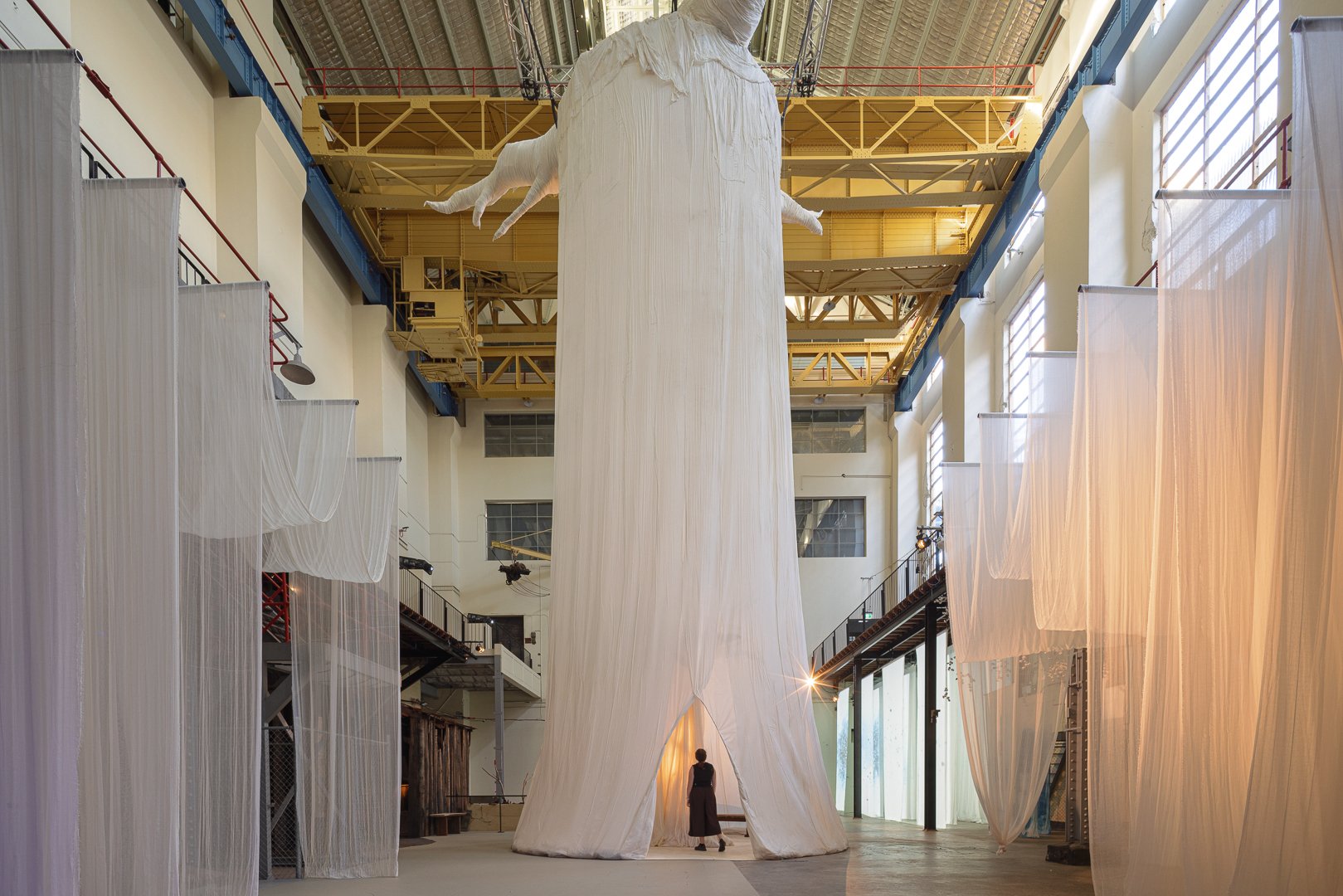
- Internationally acclaimed interdisciplinary artist Nikesha Breeze presents an immense new immersive and interactive installation titled Living Histories spanning two stories at White Bay Power Station. Working from a global African diasporic and Afro-Futurist perspective, Breeze explores first-hand accounts of enslaved African-Americans in the Antebellum South. Unfolding among large-scale fabric columns crafted to resemble the African Baobab tree, Living Histories amplifies these lost voices as an act of archival reclamation.
- Melbourne-based textile artist Ema Shin exhibits her largest work to date, a two-meter-tall 3D handwoven heart, at the Chau Chak Wing Museum. Inspired by a treasured family tree kept by her grandfather spanning 32 generations and including only the names of male family members and women who have given birth to sons, Shin’s works are a meditation on the historic and cultural erasure of women, and a tribute to the women who are absent from her family history.
- At the Art Gallery of New South Wales, Frank Young and The Kulata Tjuta Project present an installation of up of 2000 hand-carved spears by men in the community, presented in a monumental arch-like form. Accompanied by a selection of Frank’s paintings that document community stories and the spear creation processes, this project represents cultural continuity and community engagement. A performance by several men from the community (who crafted the spears) will occur at the beginning of the exhibition, to activate the space and welcome the works to the gallery and Gadigal land.
- Artists Behrouz Boochani, Hoda Afshar and Vernon Ah Kee, present a multi-channel video work at Campbelltown Arts Centre as part of their newly commissioned Code Black/Riot Centring the voices and experiences of Indigenous youth living in detention Code Black/Riot confronts the persistence of colonial policies through the inhumane logic of Australia’s incarceration system.
- Lebanese filmmakers and artists Joana Hadjithomas & Khalil Joreige create a new work exploring patterns of human migration. The installation is based on the story of a group of friends who dream of changing their lives and decide to leave their neighbourhood for Australia, ultimately reaching Christmas Island. Their migration crosses the path of the annual mass red crab migration, which sees millions of large crabs emerge from the forest and make their way to the ocean to breed. The immersive multimedia installation at Campbelltown Arts Centre explores constant movement, migrations, dreams and imaginaries of utopian “elsewheres”.
- Respected Yindjibarndi Elder Wendy Hubert expands her arts practice to create a large-scale native plant garden that celebrates ancestral knowledge at Lewers: Penrith Regional Gallery. Focussing on native plants that are used for food, medicine, and ceremonial purposes, the garden is a space for communities to gather, learn, and yarn.
- Monica Rani-Rudhar presents a vibrant and poetic new multi-channel video installation exploring the colonial legacies of both trauma and resistance embodied in family stories, heirlooms and bloodlines. This work at Lewers: Penrith Regional Gallery uses Rani-Rudhar’s personal history to interrogate the dual ideas of inheritance and intergenerational trauma.
- Tāmaki Makaurau (Auckland) based artist Benjamin Work, of Tongan and Orcadian/Shetlander hohoko (lineage), presents a new commission at Chau Chak Wing Museum. Symptomatic of a sprawling colonial project throughout the region, archival records of Tonga during the 19th century show Work’s ancestors merging Western clothing and materials with traditional Tongan dress. Acknowledging these developments as a means to maintain autonomy under annexation pressure, this new work extends these adaptations in an innovative sculptural tribute to the endurance of culture.
- London-based Lebanese artist and musician Joe Namy presents a new iteration of his work Automobile, a large-scale multi-channel sound installation which uses local cars fitted out with super-modified stereo systems as his instruments. First realised in Beirut, Lebanon in 2012, each presentation of Automobile engages with local communities of auto-enthusiasts to create an energetic gathering space, for the people, with the people. The work will be presented as a free performance with registration required in Parramatta Town Square on 21 March 2026.
A dynamic public program will be presented alongside the artworks, kicking off with the opening night concert Lights On at White Bay Power Station on Friday 13 March 2026. Audiences can explore the exhibition while enjoying vibrant performances including Brooklyn-based DJ Haram, playing their signature sound mixing club beats and percussion. Other performances throughout the evening include prolific local DJ and co-host of the weekly Latin American music show Mi Gente/My People on FBi radio Maz alongside Baile Funk collective INBRAZA Baile, groundbreaking inter-cultural First Nations fronted contemporary music ensemble Hand to Earth activating the resonant potential of the cavernous space of the Turbine Hall, American artist Niecy Blues, who merges soul, ambient and spoken word, and a preview performance of Joe Namy’s Automobile.
During the opening weekend from 14-15 March 2026, free performances, talks and art activations will take place. A series of Spotlight Artist Talks, where artists present alongside their works, will include exhibiting artists Natalie Davey, Edgar Calel, Carmen Glynn-Braun, Ángel Póyon and more. Performances will activate the artworks of Nikesha Breeze and Marian Abboud, and a special musical performance by Indigenous artist Nancy Yukuwal McDinny with her son, daughter and sister, alongside her new series of paintings depicting the dramatic roll clouds of her Country for the exhibition. At Lewers: Penrith Regional Gallery, Wendy Hubert’s Indigenous plant garden installation will host talks and yarning circles.
The Art After Dark program will transform White Bay Power Station on Friday evenings with music, art and outdoor food markets. The first three events are curated by Liquid Architecture, with performances by dynamic musicians including Tujiko Noriko and Mara Schwerdtfeger on 20 March, Ruhail Qaisar and Marcus Whale on 27 March, and Liam Keenan and Allara Briggs-Pattison on 3 April. The Inner West Council presents a music series across three nights, with performances by Body Type on 17 April, Yes Boone on 24 April and BOY SODA on 1 May. Announced this week, Vivid Sydney curates the final three nights, with acclaimed Brooklyn-based ambient techno trio Purelink performing on 29 May, French-Senegalese, London-based singer-songwriter anaiis on 5 June, and the Biennale of Sydney Closing Night Party on 12 June will feature a free multi-stage party with music from across the globe. Lineup to be announced.
A range of additional programs will take place throughout the three month long festival, including Memory Lane Food Markets each Saturday, a large-scale festival for Africa Day in May, six new performance commissions in partnership with the Inner West Council, general art tours, history tours of White Bay Power Station in partnership with Museums of History NSW, Family Days, Youth programs, education programs and access programs.
Artists as part of the 25th Biennale of Sydney (2026) are:
Art Gallery of New South Wales
Abdul Abdullah (Australia / Thailand)
Angélica Serech (Maya Kaqchikel, Guatemala)
Chang En Man (Paiwan, Taiwan)
Dindga McCannon (USA)
Elverina Johnson (Yarrabah, Australia)
Frank Young and The Kulata Tjuta Project (Aṉangu Pitjantjatjara Yankunytjatjara (APY) Lands, Australia)
Kapwani Kiwanga (Canada / France)
Kuba Dorabialski (Poland / Australia)
Maritea Dæhlin (Norway / Mexico)
Merilyn Fairskye (Australia) & Michiel Dolk (Netherlands / Australia)
Nahom Teklehaimanot (Ethiopia / Kenya)
Ngurrara Artists (Walmajarri, Mangala, Juwaliny, Wangkajunga, Manjilarra / Great Sandy Desert, Australia)
Rose B. Simpson (Santa Clara Pueblo, USA)
Sandra Monterroso (Maya Q’qchi’, Guatemala)
Taysir Batniji (Gaza, Palestine / France)
Yaritji Young (Aṉangu Pitjantjatjara Yankunytjatjara (APY) Lands, Australia)
Campbelltown Arts Centre
Basel Abbas (USA / Palestine) and Ruanne Abou-Rahme (USA / Palestine)
Basil Al-Rawi (Ireland / Iraq)
Behrouz Boochani (Kurdistan / Iran / Aotearoa (New Zealand)), Hoda Afshar (Iran / Australia) and Vernon Ah Kee (Kuku Yalandji, Waanji, Yidinji and Gugu Yimithirr, Australia)
Dread Scott (USA)
Feras Shaheen with Jonny Scholes
Helen Grace (Australia)
Joana Hadjithomas (Lebanon / France) and Khalil Joreige (Lebanon / France)
Mounira Al Solh (Lebanon / Netherlands)
Nasri Sayegh (Lebanon)
Nil Yalter (Turkey / France)
Norberto Roldan (Philippines)
Vicente Telles (USA)
Chau Chak Wing Museum at the University of Sydney
Belinda Kazeem-Kamiński (Austria)
Behrouz Boochani (Kurdistan / Iran / Aotearoa (New Zealand)), Hoda Afshar (Iran / Australia) and Vernon Ah Kee (Kuku Yalandji, Waanji, Yidinji and Gugu Yimithirr, Australia)
Benjamin Work (Tonga / Aotearoa New Zealand)
DAAR (DECOLONIZING ARCHITECTURE ART RESEARCH) (Palestine)
Derek Ogbourne (United Kingdom)
Dorothy Cross (Ireland)
Ema Shin (Japan / Australia)
Khalil Rabah (Palestine)
Lamia Joreige (Lebanon)
Michael Rakowitz (USA)
Niamh McCann (Ireland)
Richard Bell (Kamilaroi/Kooma/Jiman/Gurang Gurang, Australia)
Tuấn Andrew Nguyễn (Vietnam / USA)
Warraba Weatherall (Kamilaroi, Australia)
Lewers: Penrith Regional Gallery
Chang Wen-Hsuan (Taiwan / Netherlands)
Deirdre O’Mahony (Ireland)
Fernando Poyón (Maya Kaqchikel, Guatemala)
John Harvey (Kalaw Kawaw Ya/Saibai Island, Torres Strait, Australia) & Walter Waia (Kalaw Kawaw Ya/Saibai Island, Torres Strait, Australia)
Keith Piper (United Kingdom)
Khalid Albaih (Sudan / Norway / Qatar)
Kulpreet Singh (India)
Massinissa Selmani (Algeria / France)
Monica Rani Rudhar (Australia)
Nil Yalter (Turkey / France)
Nora Adwan (Palestine / Ireland / Norway / UK)
Wendy Hubert (Yindjibarndi Country, Australia)
White Bay Power Station
Abdullah Al Saadi (United Arab Emirates)
Ángel Poyón (Maya Cakchiquel, Guatemala)
Autumn Chacon (USA)
Bertille Bak (France)
Bouchra Khalili (Morocco / Austria)
CAMP (India)
Cannupa Hanska Luger (Standing Rock Indian Reservation, North Dakota / New Mexico, USA)
Carmen Glynn-Braun (Kaytetye, Arrernte, Anmatyerr, Australia)
Chen Chieh-jen (Taiwan R.O.C.)
Daisy Quezada Ureña (USA)
Dennis Golding (Kamilaroi/Gamilaraay/Biripi, Australia)
Edgar Calel (Kaqchikel, Guatemala)
Emily Jacir (Mediterranean)
Frank Sweeney (Ireland)
Gabriel Chaile (Argentina / Lisbon)
Gunybi Ganambarr (Yolŋu (Ŋaymil) people, Australia)
Hou I-Ting (Taiwan)
Hui Ye (China / Austria)
Joe Namy (USA / UK / Lebanon)
John Prince Siddon (Walmajarri, Australia)
Kiri Dalena (Philippines)
Marian Abboud (Australia)
Marianne Keating (Ireland / United Kingdom)
Maritea Dæhlin (Norway / Mexico)
Nancy Yukuwal McDinny (Garrwa / Yanyuwa, Australia)
Natalie Davey (Australia)
Nikesha Breeze (United States)
Nil Yalter (Turkey / France)
Peter Kennedy (Australia)
Richard Bell (Kamilaroi / Kooma / Jiman / Gurang Gurang, Australia)
Tania Willard (Secwepemcúlecw, Canada)
Tuan Mami (Vietnam)
Marrickville Town Hall
Gabriela Golder (Argentina)
Centenary Square, Parramatta
Joe Namy (USA / UK / Lebanon)
Blouza Hall
Mounira Al Solh (Lebanon / Netherlands)
The Children’s Choir (Australia)
Sydney Town Hall
Richard Bell (Kamilaroi / Kooma / Jiman / Gurang Gurang, Australia)
Key Dates
Tuesday 10 March 2026: Media Preview
Friday 13 March: Lights On opening night
Wednesday 11 – Friday 13 March 2026: Vernissage (Professional Preview)
Saturday 14 March – Sunday 14 June 2026: 25th Biennale of Sydney open to the public
Admission is free.
For further information on the Biennale of Sydney, please visit biennaleofsydney.art.
Ends
MEDIA CONTACTS: For more information contact Articulate:
Jasmine Hersee, jasmine@articulateadvisory.com, 0451 087 196
Siân Davies, sian@articulateadvisory.com, 0402 728 462
Sasha Haughan, sasha@articulateadvisory.com, 0405 006 035
Kym Elphinstone, kym@articulateadvisory.com, 0421 106 139
IMAGES: Available to download here.
IMAGE CAPTION: Nikesha Breeze, Living Histories, 2026, cotton gauze, wood, steel, cyanotype prints, furniture, sound, video projection, paper, Music Composer: Lazarus Nance-Letcher, Vocalist: Gina Breedlove, Choreographic support: Brontë Velez, Amara Tabor-Smith, Professional Readers: Anthony Grace, April Hardy, Bahni Turpin, Bonita Brisker, Brianna S. Powell, Chad Singleton, Naadia Bakhit, Corey Brooks, Elyssa Lassiter, Felicia Boswell, Gayle Samuels, Greer C. Morrison, Jessica Funches, Masud Olufani, (Jonathan) Matthew Williams, Lauren Jillian Croom, S. Juain Young, William Delaney, Ugarhon Serrette (Sugar Johnson), Charles Reese, Live performance by Nyaluak Leth, Basjia Almaan, Andrew Bukenya, Ran Fields, Commissioned by the Biennale of Sydney, Courtesy of the artist, Photograph: Document Photography.
ABOUT THE BIENNALE OF SYDNEY
The Biennale of Sydney is a leading international contemporary art event. It plays an indispensable role in Australia’s engagement with the world, and a meaningful role in the life of the nation. For over 50 years, the Biennale has been a unifying force in the Australian arts sector, embedding boldly creative art exhibitions and experiences in the everyday life of Sydney and putting the artistic excellence of Australia front and centre on the world stage. The Biennale of Sydney has commissioned and presented exceptional works of art by more than 2400 artists from more than 130 countries and territories. The Biennale of Sydney is committed to free access for all. https://www.biennaleofsydney.art/
ABOUT HOOR AL QASIMI
Hoor Al Qasimi is President and Director of Sharjah Art Foundation, the independent public arts organisation she established in 2009 as a catalyst and advocate for the arts in the UAE and beyond. She has expanded the Foundation’s scope to include major international exhibitions; residencies; commissions; publications; grants; performance and film festivals; architectural research and restoration; and educational programming.
In 2003, she co-curated Sharjah Biennial 6 and has remained Biennial Director ever since. She was elected President of the International Biennial Association (IBA) in 2017. Al Qasimi was also curator of Sharjah Biennial 15: Thinking Historically in the Present (2023).
Al Qasimi has curated major solo exhibitions at Sharjah Art Foundation, presenting works by CAMP (2022), Khalil Rabah (2022), Tarek Atoui (2020–2021), Zarina Bhimji (2020–2021), Amal Kenawy (2018–2019) and Yayoi Kusama (2016–2017) as well as a major touring retrospective of work by Hassan Sharif (2017 – 2021). She co-curated Kamala Ibrahim Ishag: States of Oneness, Serpentine Gallery, London (2022–2023), Bani Abidi’s survey at MCA Chicago (2021–2022); and a major touring exhibition of work by Joana Hadjithomas and Khalil Joreige (2016 – 2017).
Al Qasimi curated the UAE Pavilion, 56th Venice Biennale (2015), the second Lahore Biennale (2020) and Dream Projects, Dream City Festival, Tunis (2023).
President and Director of the Sharjah Architecture Triennial, Al Qasimi also serves as President of the Global Studies University, Sharjah, which includes The Africa Institute and The Asia Institute. In 2025, Al Qasimi curated the sixth Aichi Triennale, the first non-Japanese person to do so.
ABOUT FONDATION CARTIER POUR L’ART CONTEMPORAIN
The Fondation Cartier pour l’art contemporain is a space for artistic dialogue and experimentation that places the relationship between creation and exhibition at the heart of its institutional project, working in close collaboration with artists.
Since its creation in 1984 by Alain Dominique Perrin, then-President of Maison Cartier, it has exhibited artists from all walks of life, breaking down barriers between practices and fields of thought. Built over the years through a groundbreaking international programme, the Fondation’s collection reflects its multidisciplinary nature and the breadth of themes addressed in direct connection with contemporary issues.
The Fondation Cartier carries out its activities and commitments with the desire and ambition to make contemporary creation accessible to the widest possible audience. Through exhibitions projects and a programme of encounters and debates, live performances and talks, it creates bridges between cultural venues and fosters a genuine space for multicultural dialogue. With a new exhibition space, conceived by the renowned architect Jean Nouvel, on Place du Palais-Royal in Paris, the Fondation Cartier is reinventing itself in order to experiment and share with artists and audiences alike ever new ways of conceiving art.
Find out more here: www.fondationcartier.com
IMAGE CAPTION: Nikesha Breeze, Living Histories, 2026, cotton gauze, wood, steel, cyanotype prints, furniture, sound, video projection, paper, Music Composer: Lazarus Nance-Letcher, Vocalist: Gina Breedlove, Choreographic support: Brontë Velez, Amara Tabor-Smith, Professional Readers: Anthony Grace, April Hardy, Bahni Turpin, Bonita Brisker, Brianna S. Powell, Chad Singleton, Naadia Bakhit, Corey Brooks, Elyssa Lassiter, Felicia Boswell, Gayle Samuels, Greer C. Morrison, Jessica Funches, Masud Olufani, (Jonathan) Matthew Williams, Lauren Jillian Croom, S. Juain Young, William Delaney, Ugarhon Serrette (Sugar Johnson), Charles Reese, Live performance by Nyaluak Leth, Basjia Almaan, Andrew Bukenya, Ran Fields, Commissioned by the Biennale of Sydney, Courtesy of the artist, Photograph: Document Photography.